
How a Missing Tooth Can Lead to Shifting Teeth, Bite Changes, and Long-Term Oral Health Problems in Sylacauga
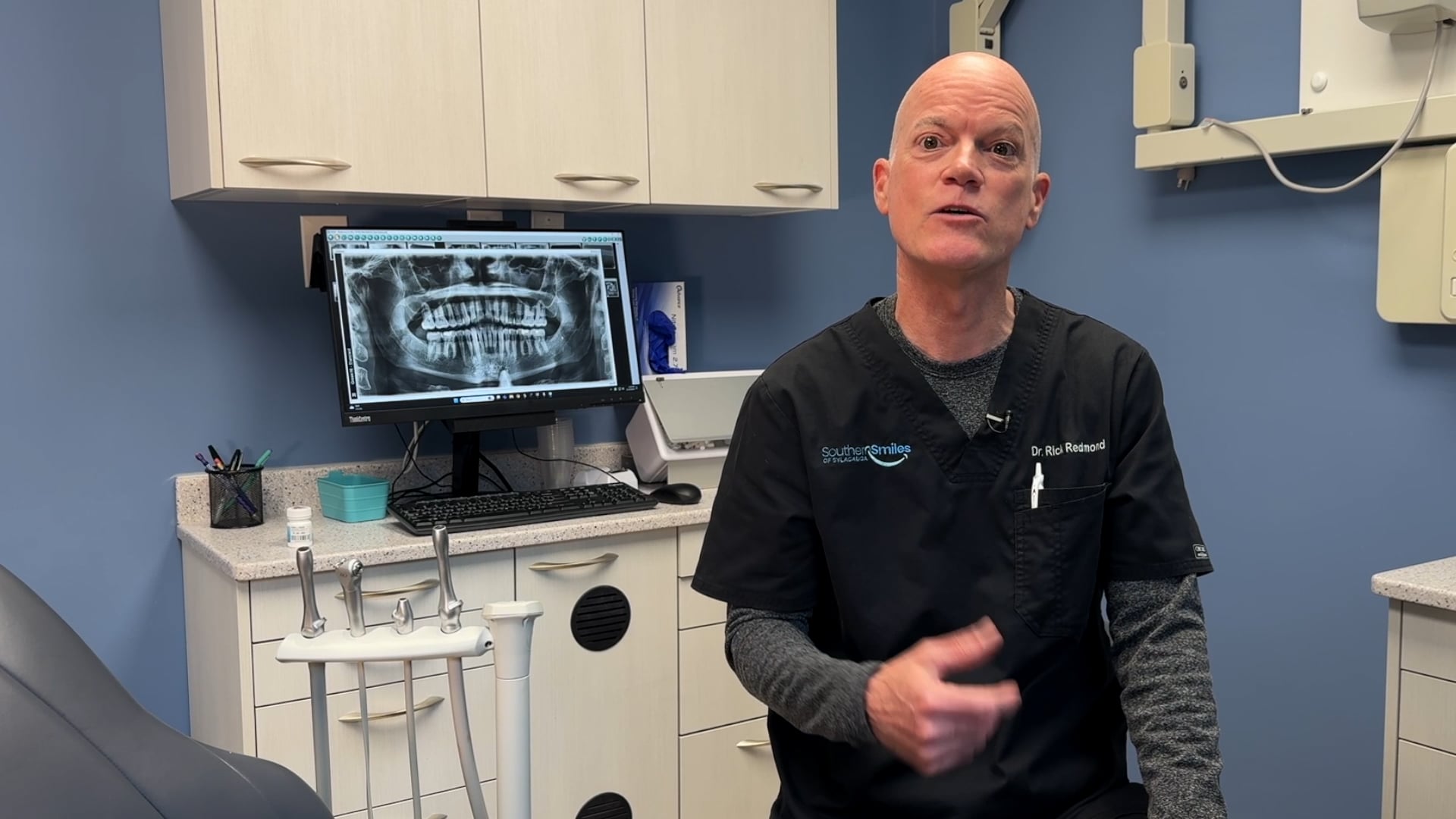
In this video, Dr. Rick Redmond explains why a missing tooth is rarely “just a cosmetic issue.” Even if the gap is in the back where it is harder to see, the mouth is a system. When one part is missing, other parts start to adapt, and not in a good way.
Our office is in Sylacauga, and we often see patients who drive in from nearby communities such as Childersburg, Talladega, Alexander City, Goodwater, and surrounding areas. A common theme is that many people wait longer than they intended to, then they are surprised by how much has changed since the tooth was lost.
Dr. Redmond’s message is simple: replacing a missing tooth helps keep everything stable, and stability is a big part of long-term oral health.
Why Teeth Shift When a Tooth Is Missing
Teeth like to touch other teeth. When a tooth is missing, the teeth on each side of the gap can slowly drift and tip toward the open space. Instead of staying upright, they can lean in.
That creates a chain reaction:
- The neighboring teeth can tip into the gap, which changes how they meet the opposing teeth.
- The bite can become less stable as those teeth lose their ideal position.
- Spaces and food traps develop because the teeth are no longer tight together.
This is why people who are missing a tooth often start to notice that flossing feels different or that food packs into the area more easily. What started as “one missing tooth” becomes an ongoing annoyance that can also turn into a health problem.
The Opposing Tooth Can Drop Down Over Time
Dr. Redmond also describes another common change that happens after tooth loss: the tooth on the opposite jaw may begin to shift down toward the open space.
For example, if you are missing a lower tooth, the upper tooth that used to bite against it has nothing to touch anymore. Over time, it can drift downward until it meets one of the teeth that has tipped into the space.
That might sound minor, but it can lead to:
- Uneven bite forces and additional stress on certain teeth
- More difficult cleaning in the shifted areas
- Changes in how your jaw functions as the bite becomes less balanced
Once teeth shift, it is not always as simple as “just put something in the gap.” The earlier the tooth is replaced, the more likely it is that the surrounding teeth stay in their healthy positions.
Food Packing, Cavities, and Gum Disease Risk
One of the most practical problems Dr. Redmond mentions is food packing. When teeth move and spaces open up, it becomes easier for food to get trapped. That is frustrating in the short term, and it can lead to bigger concerns over time.
Why Food Packing Matters
When food frequently gets stuck between teeth, it can irritate the gums and increase plaque accumulation. Over time, that can contribute to:
- Inflammation and gum irritation around the area
- Higher cavity risk in the teeth next to the missing space
- Gum disease progression because the area becomes harder to keep clean
Many people who are missing a tooth focus on the missing tooth itself. Dr. Redmond’s point is that the health of the neighboring teeth is often what suffers first.
Why Replacing the Tooth Helps Keep Everything Stable
In the video, Dr. Redmond explains that restoring a missing tooth helps keep the bite stable and reduces the long-term risk to surrounding teeth and gum health.
When a missing tooth is replaced appropriately, the neighboring teeth have support. They are less likely to drift, tip, or create gaps. The opposing tooth is less likely to over-erupt into the open space. The bite becomes more stable again.
Stability is not just about comfort. It is about preventing the slow changes that can lead to additional treatment later.
How Dr. Redmond Evaluates a Missing Tooth for an Implant
If a patient is missing a tooth and wants to restore it with an implant, Dr. Redmond starts with a 3D CT scan. The goal is to evaluate the bone in three dimensions and determine how much bone is available to work with.
This matters because implant placement is a precision procedure. The CT scan helps the dentist plan placement with respect to the bone, the bite, and the surrounding anatomy.
What the CT Scan Helps Reveal
- Bone height and bone width at the missing tooth site
- Bone density, which affects stability during placement
- Positioning and spacing relative to adjacent teeth
- Anatomy considerations that influence safe placement
For many patients in Sylacauga and the surrounding area, that CT evaluation brings clarity. Instead of guessing or hoping, you get a plan based on what your bone can support.
What the Implant Appointment Is Like
Dr. Redmond explains implant placement in a way that makes it feel familiar: the area is numbed just like it would be for a standard dental procedure. Then a small pilot hole is created, the implant is placed, and in many cases a temporary crown can be placed the same day.
There are two important patient-centered takeaways in that statement:
- Comfort is prioritized by thoroughly numbing the area.
- Many cases allow for a temporary crown so you are not left with a visible or functional gap.
Not every case is identical, and timing depends on how strong the implant feels at placement and what the bone density is like. But for many patients, this process is far more straightforward than they expect.
How Long Until the Final Porcelain Crown?
In the video, Dr. Redmond shares a typical time frame for moving from a temporary crown to the final porcelain crown. Depending on bone density and how the implant stabilizes at placement, the final crown is often completed anywhere from six weeks to three months after implant placement.
This window allows time for healing and integration. The body needs time to form a strong connection between the bone and the implant. That is what creates the stable foundation required for a long-lasting final crown.
Why the Timeline Can Vary
- Bone density differs from patient to patient and affects early stability.
- Implant location can influence how much force the area experiences while healing.
- Overall oral health impacts how the tissues respond during recovery.
During your consultation, you can expect a clear explanation of what timeline makes sense for your specific situation.
Common Questions Patients Ask About Replacing a Missing Tooth
Is it really a problem if the missing tooth is in the back?
Even when the gap is not visible in your smile, the teeth around it can still shift, food can still pack into the area, and the bite can still become less stable over time.
If my teeth already started shifting, can an implant still help?
An implant can still be an excellent option, but shifted teeth may require additional planning. The best time to address a missing tooth is before movement creates bigger spacing and bite issues.
Do I have to wait a long time before getting a crown?
Dr. Redmond notes that many cases move to a final porcelain crown in about six weeks to three months, depending on bone density and stability at placement.
Do patients travel in for this care?
Yes. Our office is in Sylacauga, and we regularly see patients who travel from nearby communities such as Childersburg, Talladega, Alexander City, Goodwater, and surrounding areas. All treatment takes place at our Sylacauga location.
Talk With Our Team About Replacing a Missing Tooth
If you are missing a tooth, an implant may be an option to restore function and help keep your bite stable. The first step is an evaluation with 3D imaging so you can understand your bone and your options clearly.
Southern Smiles of Sylacauga
Dr. Rick Redmond, DMD
101 S Douglas Ave
Sylacauga, AL 35150
Phone: ((256) 245-3645)
Medical Review by Dr. Rick Redmond, DMD
This article has been medically reviewed by Dr. Rick Redmond, DMD to ensure clinical accuracy and patient-appropriate guidance regarding tooth loss, bite changes, and dental implant treatment planning.
Dr. Redmond pursued his DMD at the University of Alabama at Birmingham (UAB) School of Dentistry. He also attended a residency at Washington Dental School Hospital and recently completed a Comprehensive Implant Residency Program in Birmingham. He is a member of the American Dental Association, the Alabama Dental Association, and the Academy of General Dentistry.
Learn more about Dr. Redmond: https://southernsmilesofsylacauga.com/about-us/
